
Date/Time
Date(s) - 12/05/2020
13:30 - 15:30
Instructor
Mareike Smolka
Categories
Organizer: Mareike Smolka
Mareike Smolka is a Junior Teaching Fellow at the University College and a PhD candidate at the Faculty of Arts and Social Sciences of University Maastricht. Her expertise is in qualitative research, in particular ethnography. For her PhD research she has spent more than half a year in a biomedical research group in France where she observed, interacted with, and interviewed numerous researchers about ethical challenges and problems that occur in their daily work practices. For that purpose, she has been trained by and has collaborated with Professor Erik Fisher from Arizona State University. He developed the STIR method to both study and improve responsible research in science and technology development (https://cns.asu.edu/research/stir).
Workshop description:
STIR stands for Socio-Technical Integration Research. It is a qualitative research method that has been used by researchers from the humanities and social sciences to STIR up the work of natural scientists, engineers, and other professionals. STIR studies differ from traditional ethnographies primarily because they involve co-descriptions of participants and researchers who seek to feed research insights back into the field of study. In other words, STIR researchers interact with and thereby change the research setting. The goal is to enable reflexive learning and to assess the practical value of that learning to participants and others.
For this purpose, STIR researchers make use of a decision-making matrix that they fill out together with a professional on a regular basis in order to map and unfold the professional’s everyday decision-making processes. The matrix serves as a basis for dialogue and collaborative reflection about the variety of ethical, social, material, juridical, and scientific considerations that play a role when developing possible alternatives to react to a problem, challenge or opportunity. In this way, STIR studies have helped professionals to develop creative ideas and make informed decisions that integrate a wide range of social and other considerations.

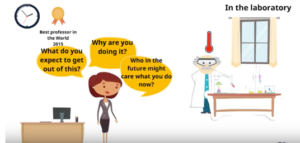
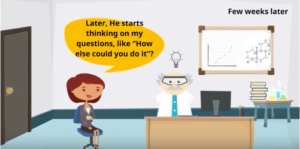
The STIR method, thus, pursues a twofold agenda: to both study and improve work practices. It has realized this agenda beyond scientific and engineering laboratories; for instance, in businesses, architectural offices and energy supply initiatives. The method may be used in any other context. You could STIR a fellow student to unfold and support his or her decision-making process when writing, a paper, studying for an exam or carrying out a (research) project.

What are the methodology and/or methods that the workshop will cover?
In this workshop you will gain hands-on experience with using the STIR method. You will learn to use the STIR matrix and how to move through its four quadrants: Opportunity – Considerations – Alternatives – Outcomes.
We will discuss which questions to ask, which comments to make (and not to make), how to feed back to your participant what you observe during the STIR dialogue, and how to analyze a transcription of the dialogue later in order to assess practical outcomes.
The 2-hour workshop will take place in a zoom video chat. Although we will meet virtually, the workshop will be interactive and you will spend most of the time doing STIR exercises with a fellow student and discussing these exercises in a group.
To participate in this workshop, you will need to prepare the following material(s):
No mandatory preparation work is required for this workshop. However, if you are curious to find out more about STIR before or after attending the workshop, you could watch the following videos:
-
- an introduction to the STIR interview method: https://vimeo.com/148687460
- Erik Fisher’s experience with using STIR: https://vimeo.com/149086757
At the end of this workshop, you will have obtained the following skills:
- Gain more experience in dialogue-based qualitative research
- Practice feeding back (preliminary) analysis and insights to research participants to stimulate a mutual learning process
- Combine social science research with practical contributions to the field under study
- Learn to analyze transcribed qualitative research dialogues
Workshop Format:
2-hour workshop on Zoom with presentation and group work.
– – Registrations open on 30 April 2020 at 18:15, and close on 4 May 2020 at 13:00. – –
Bookings
Registrations are currently closed for this event.