
Date/Time
Date(s) - 06/05/2019
13:30 - 15:30
Instructor
Costas Papadopoulos and Susan Schreibman
Location
0.022
Categories
Organizers: Costas Papadopoulos & Susan Schreibman
Costas Papadopoulos is an Assistant Professor in Digital Humanities and Culture Studies and Susan Schreibman is Professor of Digital Arts and Culture at the Faculty of Arts and Social Sciences, Maastricht University. and Both work in the area of digital humanities and digital cultural heritage, remediating physical objects (from historical documents to archaeological artefacts) into digital formats. They have managed many projects in which design thinking approaches have contributed to the project’s successful completion. They are the co-developers of #dariahTeach, an online platform for teaching Digital Humanities. As part of this platform, they are currently developing a course on ‘Design Thinking and Making for the Arts and Sciences’ (https://ignite.acdh.oeaw.ac.at/) that will be made publicly available in September 2019.
Workshop description:
Design thinking is many things to many disciplines. It is a method, a process, and a way of thinking. Above all, it is a user-centered approach to design. Designing what, you might ask? Well almost anything, from software to buildings, to exhibitions. It is used in a wide variety of disciplines, from engineering to business to heritage studies. It embraces an iterative rather than a linear approach to project management, does not shy away from missteps or failures, and encourages prototyping and testing.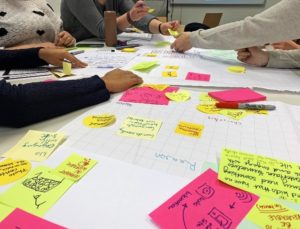
A design thinking approach encourages creative and practical problem solving and making sure the problem being solved is appropriate for the community for which it is being designed. And while this sounds intuitive, it isn’t always. How many times have you heard of a product being created for a demographic that does not have a need for it, or a bridge in a city center designed for vehicular traffic, but nobody thought that pedestrians and bicyclists would also want to use it, or software that is so anti-intuitive that it’s impossible for its users to understand it without significant documentation/training.
Design thinking is a practice that helps you not to make these mistakes (although you may make others!). It can be used for any type of problem to be solved: from group projects to your thesis. In this two-hour workshop we will introduce you to the principles of design thinking: how to define the problem, explore solutions to solve it, prototype to test your ideas, and then evaluate what you have created. You will work in teams on an exercise encompassing these principles to get hands-on design thinking experience.
What are the methodology and/or methods that the workshop will cover?
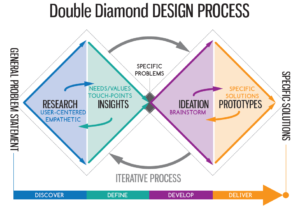
We will introduce a number of design thinking methods and approaches, utilizing what is known as the ‘double diamond’ approach to problem solving, which represents the design process through four stages: Discover – Define – Develop – Deliver. Using a practical hands-on approach, students will employ creative design methods and interactive exercises to respond to challenges, and develop creative solutions.
To participate in this workshop, you will need to prepare the following material(s):
What the following videos:
- What is Human-centered Design: https://vimeo.com/106505300
- FHIL | Stages of Design Thinking | All stages: https://www.youtube.com/watch?v=GFffb2H-gK0
- An Introduction to design Thinking: Process Guide: https://dschool-old.stanford.edu/sandbox/groups/designresources/wiki/36873/attachments/74b3d/ModeGuideBOOTCAMP2010L.pdf
At the end of this workshop, you will have obtained the following skills:
- Understand the importance of design thinking principles in responding to challenges;
- Develop design-thinking skill sets and know how to apply these to different projects;
- Being comfortable with structuring and performing workflows for conceptualizing, prototyping, and realizing solutions and/or products using a variety of tools and methods;
- Comprehend the principles of the Double Diamond design process and apply creative methods to go through the four stages of the process;
- Master ideation processes;
- Apply user-centered design methods as a way of responding to user insights;
- Create visual frameworks to represent findings;
- Practice Rapid Prototyping using e.g. mockups, prototypes, role-play etc.;
- Develop strategies for strategic flexibility, working collaboratively, and thinking creatively;
- Use the design thinking approach in a (focus) group for both problem-solving and researching participants’ needs and perspectives
Booking is available from 23 April at 18:15.
Bookings
Registrations are currently closed for this event.